by Lia
Our dedicated teachers and volunteers know the importance of teaching math and languages (Kiswahili and English) to the children. We are always looking for pedagogically sound and imaginative ways to do this (see video). Therefore, we would like to build a Learning Landscape. This is a grid-based playground for elementary math education. The playground combines active movement and competition with mathematical exercises, providing an outdoor classroom framework for fun and engaged learning.
We need 360 USD in funding for building- and instructional materials.
We are happy to announce that Didem B. has donated the needed funds (150 USD) to buy a sturdy hand-loom for Mercy W. Mercy was born almost fully lame on one side of her body. The loom and starting materials will be of great assistance for her as a form of occupational therapy, as well as a way for her to have fun experimenting with colours and different types of wool.
By Lia
Clayton, Francis, and an anonymous donor from the US have kindly donated funds to help pay for the teachers salaries and to pay for some school supplies for the children.
I am just about ready to send a care package to the children with the supplies. I decided to include a few items that might not be pedagogically useful, but certainly some fun. The list of the items to be sent are:
School supplies: pencils, scissors, tape, colouring pencils, chalk, children’s bible, math work sheets, pencil sharpeners, colouring stencils, paper cut out figures, and blackboard brushes.
The not so school supplies: water balloons, ping pong balls, and soap bubble kits.
I hope that the children and teachers enjoy the new supplies. Thank you very much for helping us.
By Rev. Wasike
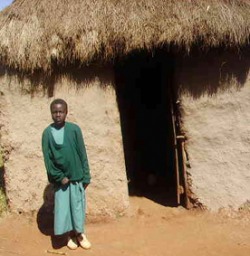
Immediately after Jennifer donated the money, I called the families through the one of board members and communicated about the donations and their intended purpose. When Kundu’s father received information about the donated seeds, it was God's timings that the father and Kundu plus others in the family seriously became engaged preparing their land for planting.
This gift really enabled this particular family to approach the year in a different style. Kundu and his siblings plus the father are without mother, and though they have land they have been compelled to hire out the same land at a small fee for many years since they never had means to farm the land themselves.
Now they could finally grow their own food. Since the family could not afford a tractor or oxen to come by to plough the land, they had to do it by hand (hoe). Even though this is a slow way of preparations, they had completed a big portion of their land by the time we went to buy the seeds.
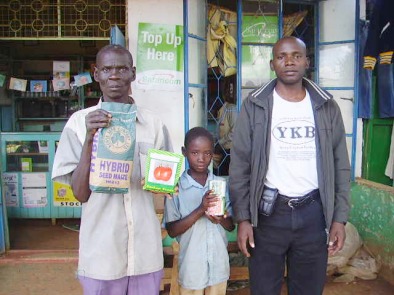
Kundu, his father, and Rev. Wasike
Originally, I had wished to buy the seeds in Nairobi, but communication with the family forced me to go and make them select what type crop seeds they thought they could manage without more inputs from outsiders. They had very set ideas about what they wanted to grow. So when I was in Kimilili last week, right away Kundu plus his father and I went into town to buy the seeds in the Agrovet shop.
At this stage, I was a bit surprised with Kundu’s reaction. He did not indicate much happiness, but acted as if it as normal for him to receive the seeds. Then, I looked at Kundu’s father and was challenged when I saw tears flowing, upon receiving the seeds. In fact, he said that did not believe it would happen. He had done all the preparation not quite believing it would actually happen. When handed him his seeds, he wanted to leave immediately. He didn’t even want to stop to take a photo.
It was a cloudy day and showing signs of rain. He just excused himself, saying that he wanted the day's rain to find his seeds in the soil. Two or three hours later, I went to his home because I wanted to discuss with him a difficult situation that persisted for the last few months. And that was, he refused to let Kundu go to school and instead got Kundu casual work looking after cattle for the neighbourhood.
Upon reaching the home of Kundu, I was shocked to see everyone out on the plot of land planting the seeds. It was almost impossible for me to get Kundu’s father to sit down with me to discuss this matter close to my heart, even though I sacrificed time needed with other community members to go there.
As far as one could see, there was a beehive of activity on the plot of the land of Kundu’ family planting the seeds. The father and elder children plus Kundu himself were at peace; joyful and energetic to go the extra mile as long as it meant planting their own food.
I had a short chat with the father and he promised to send Kundu back to school when the school terms start again. Not, only do the seeds provide the family with food, they also enable Kundu to go to school. Among all those who received gifts from Jennifer, my personal rating noted that Kundu’s family saw God through the seeds.
By Rev. Wasike
Our garden project started as many project here start, by taking small steps with big hearts and strong wills. Since the plot of land that our temporary school stands on is too small, the planting was done in various places in the area; depending on the free portion of land donated for this season by the Kimilili community.
We managed to plant cassava plant, maize, cow peace, and kale (sukuma wiki). We are hoping to raise some funds so that we can purchase some land adjoining the school, as well as a plot of land 15 minutes walk away that is bordering on the river.
Written by Muna
For the average child born in a developed country, Christmas, Easter and their birthday bring many opportunities to garner myriad of toys from friends, family and acquaintances alike. Most of these toys do not hold the child's attention for long, or maybe they are abandoned for another favorite" toy, or eventually they are passed on as donations to the thrift store or the less fortunate when a new "fancier" toy is acquired. However, this little fact does not take away from the utter joy that a child feels when being showered with a gift, regardless of which corner of the world they grew up in.
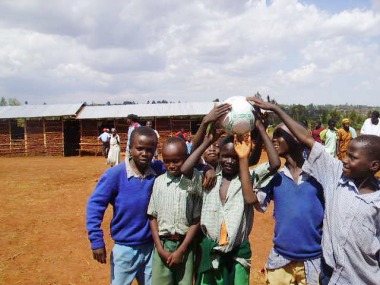
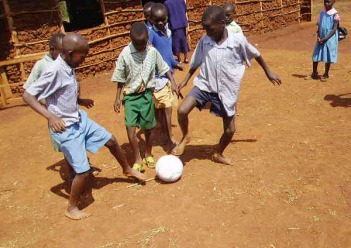
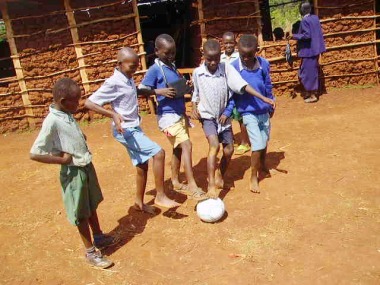
So, when little Fadhili, a young student at the Community Breakthrough Support Mission school in Kimilili, Kenya, received a football as a gift from Jennifer (in USA), the utter joy and excitement that he and his classmates felt at receiving such a gift rivals the excitement any child would feel if they were to stay a month in Santa Claus’s toy workshop or even at Willy Wonka’s chocolate factory!
Reverend Wasike purchased the deflated football in Nairobi and brought the gift up to Kimilili to deliver it to Fadhili. When the ball was handed over to him, he was in the school compound with his other schoolmates. In its current deflated state, the ball was not much fun to play with, so Fadhili and his friends rushed into town with much exuberance to inflate the ball. With the task completed, the boys headed back to the school compound and were ready to show off their skills on the playing field.
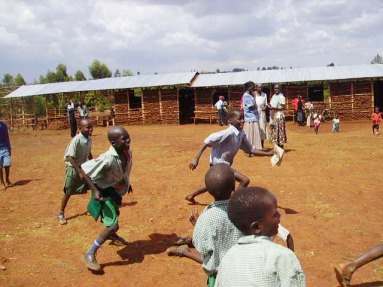
Having never seen an actual football until then, chaos fueled by overwhelming excitement ensued amongst the kids, as one could only expect. Their childlike squeaks and squeals of excitement drew the attention of the adults who were having a meeting nearby, out into the playing field to see what was happening. What greeted them was nothing short of a comical performance by several young boys staging a display of their football skills.
In their excitement and attempts at play, all rules known to the agile game of football were quickly abandoned. There was no order to the game; the boys were jumping for the ball, running up and down the field, left and right, with each player trying his best to kick the ball. They were all so overwhelmed by this new toy that the game they played had no rhyme or reason to it, but then nobody cared. Each boy was trying furiously to shoot at the ball with his little feet or head. Since there was only one ball for the whole lot of them, many spent the day kicking their feet, or shooting their heads into thin air rather than connecting with the ball. But again, this did not matter. Even the ones who never got the chance to hit the ball would have it no other way. This realization did not devalue the fun they had playing with the football.
The teachers were also drawn into the field, as the noise got louder. They tried their best to impose some order to the mayhem. First, they attempted to isolate Fadhili with the ball so he could play alone with it; after all it was his new toy. But, this was a completely unrealistic situation to enforce and everyone could see that it did not and would not work. The other kids were too curious to stay away from Fadhili. The teachers decided it wise to allow the kids to play freely. Fadhili did not mind in the least sharing his new toy either as long as he was elected team captain.
Even though some kind of decorum was established, the teachers had to still be on high alert. As the saying goes, “boys will be boys”, so it did not take long for complaints of injuries and the like to start flocking in. It seemed the neighborhood children were also being affected by the overwhelming joy coming from the school playing field. It wasn’t long before the boys from the neighborhood were also running for the ball along with kids from the school. Everyone wanted to get involved, everyone except the neighborhood girls who stood by watching in awe from a distance.
Faster than you could say “hello”, the school playing field became too small for the game at play. The teachers and people watching believed that this was one of the reasons why there were so many injuries amongst the kids. But, other than a scratch here and there, no major injuries were reported. This was quite possibly the best day at school the children ever had! The boys will certainly attest to that.
As for little Fadhili, he proudly left the school compound that day with his new football and a guardian for security. In tow were his friends, some old and some new, but all tending to follow him around town with his new toy. Who knew that something as inconsequential as a football – one of the most undervalued toys of this modern day could bring such joy to a small community, and turn a little boy into a Star. Fadhili will remember this day for a very long time coming.
by Lia
Rev. Wasike is travelling today to Kimilili to attend the end of half term school celebrations.
He sent me the following about this event,
"I will be attending the end of term ceremony, which involves giving awards to the individual children. There are awards such as, who are best clean, best in class, best behaved, best disciplined, most improved. We try to reward our children by giving them some presents, or small sums of money (if available), to encourage them to continue their good work, or to motivate them to do better."
Rev. Wasike has promised to return with stories and many photos. He will take photos, not only of the ceremony, but also of the school garden and the children receiving the gifts Jennifer so kindly donated.
I can hardly wait to see them.
Well, we managed to complete our first school year in Kimilili. What a fine celebration we had. I would like to extend a special thanks to all our teachers, school volunteers, and children guardians. Without your tremendous help, we would never be able to care for our children as we do. My gratitude is great.
I haven't written in our blog for a while because we are so busy setting up various school and community projects. We are truly doing a juggling act at the moment.
Our school projects include setting up some more song and poetry projects for the young children's group, learning about various professions and trades for the middle children's group, and a short film project for the older children's group. We have completed the project outlines and now we are working on defining the various tasks and persons to carry out the tasks in each group.
We have also started on a new HIV/Aids youth program. We would like to create a project that goes beyond just information and counseling of our youths. We would like the youths to become active in various drama or storytelling projects as well.
I have made initial contact with persons concerning a clear water and catchment project for the community. As is often the case in the area we live, clean water is a scarcity and we have to try and find a solution to this problem. Our children's health and the health of the community suffer because they lack clean water.
We are proud to announce that we have set up a website for school classes from around the world to share with others their creativity and connection. The site is called Our Song Circle - Wimbo Mviringo. We feel very privileged to participate with you in this exchange of peace and fellowship.
Please spend some time looking through the school projects presented here. Our children would be delighted if you would consider joining Our Song Circle and making projects of your own. School classes of every age group are welcome.
|





 RSS Feed